
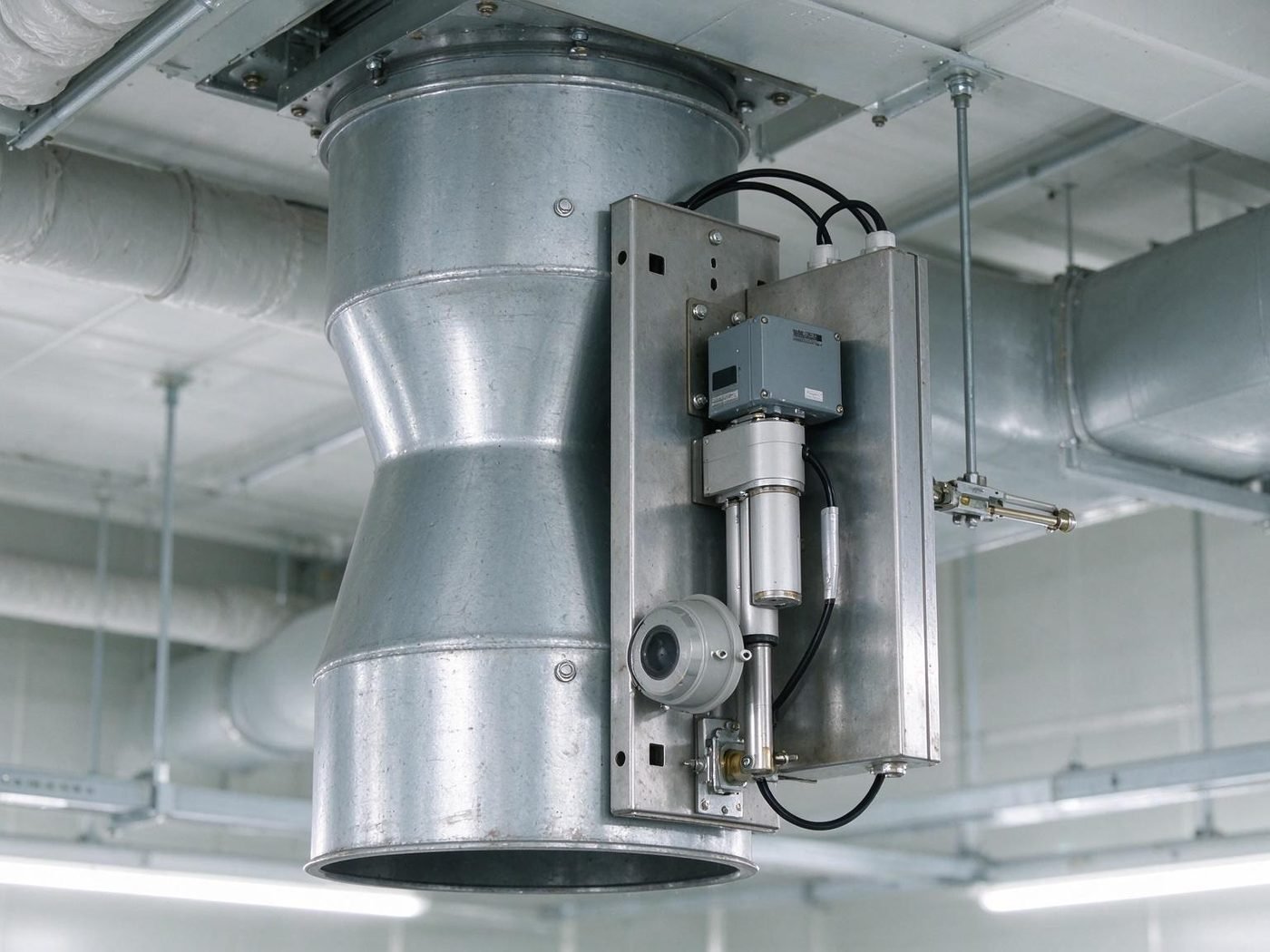
A venturi valve that stabilises and balances supply and exhaust airflow in lab ventilation and hood systems, maintaining design airflow against pressure changes.
The venturi valve adjusts automatically to maintain a set airflow despite fluctuations in duct pressure, keeping hood exhaust and room supply balanced. It supports constant-volume or variable-volume ventilation control, helping the lab hold face velocities and room pressurisation as doors open and equipment changes. Valves are sized to the airflow and duct diameter in the ventilation design.
These are standard values; anything here can be changed to suit your drawings, workload or local code. Equipment is normally specified together with the matching benches and extraction.
| Function | Pressure-independent airflow regulation in supply or exhaust duct |
|---|---|
| Control | Set airflow by actuator/control signal; CV or VAV operation |
| Sizing | Rated to design airflow range and duct diameter |
| Body | Material per air stream; galvanised, aluminium or stainless option |
| Integration | Duct-mounted; connections to the BMS or ventilation controller |
| Construction | Material and finish selected to the chemicals, washdown regime and project specification |
| Customisation | Dimensions, service positions and fittings adjusted to the project drawing |
| Packing | Knock-down or assembled, EPE foam, carton, plywood crate for sea freight |
A venturi valve actively holds a set flow as duct pressure changes; a plain damper only restricts area and its flow drifts with pressure.
Yes, valves interface to the BMS or dedicated ventilation controller; signal and wiring are laid out with the HVAC design.
Retrofit suitability depends on the duct and control scheme; we review the ventilation design before specifying.
Send the room plan, equipment list and any chemical or process notes. You get back a schedule and a factory-direct price.
Send Your Drawings